
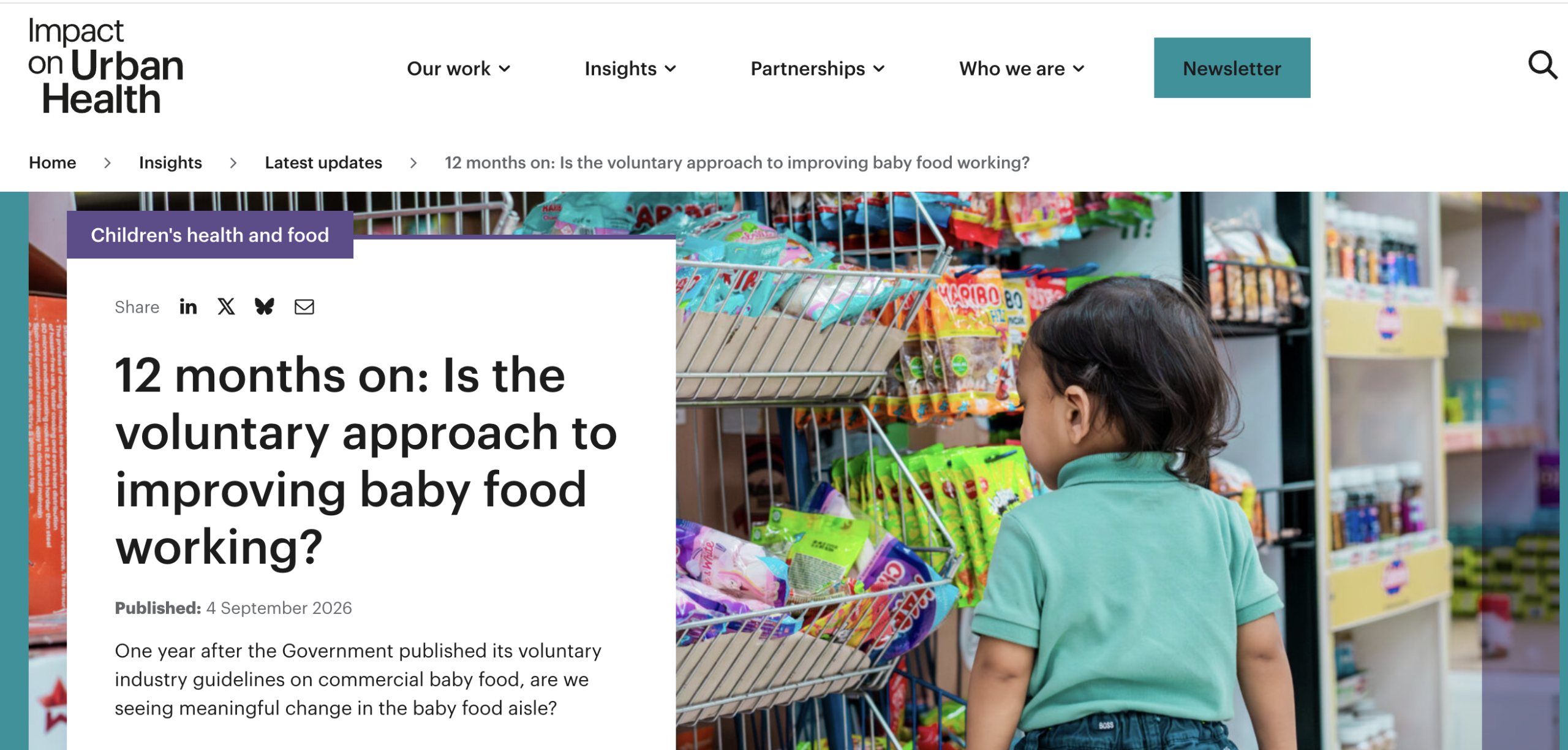
Together with Carole Coulon, of Impact on Urban Health, Rosie from the Bremner & Co team has co-authored a blog on behalf of the CBFR, reflecting on progress one year after the Government introduced voluntary industry guidelines for commercial baby food.
The Commercial Baby Food Review (CBFR) is a cross-sector initiative working to improve the nutritional quality, composition and marketing of commercial baby food in the UK through stronger regulation. Bremner & Co works alongside partners in the Review to provide coordination across workstreams and contribute strategic advice across advocacy and communications.
In August 2025 the Government published voluntary industry guidelines on commercial baby food, addressing a market that was inundated with nutritionally inadequate products and misleading marketing claims. Manufacturers were given 18 months to bring products in line with these guidelines.
With six months remaining until the February 2027 deadline, the blog examines where the market stands so far, reflects on the latest evidence on industry responses, and asks whether voluntary action is delivering the scale and consistency of change needed to create a healthier baby food market for parents and their young children.
Whilst some manufacturers and retailers are making meaningful changes – including Tesco’s relaunch of its own-brand baby and toddler range to include healthier products – progress across the market remains uneven and is not yet happening at the pace or scale required. Concerns remain not only about the nutritional composition of products, but also how they are labelled and marketed to parents. Recent analysis from Which? Illustrates the limited progress; at the halfway point of the implementation period, 18% of products still failed to meet the government’s sugar guidelines, which is the same proportion as before the guidelines were introduced.
The CBFR is conducting an evaluation of <800 baby food products against the totality of the guidelines, that will provide a comprehensive picture of how far the market has moved towards compliance across the 18-month implementation period. It will analyse changes in nutritional composition and marketing and labelling, assessing products against both the UK voluntary guidelines and the WHO Nutrient and Promotion Profile Model. This will help assess the extent of compliance across the market, whether the guidelines are sufficiently ambitious in the first place.
Read the full blog on Impact on Urban Health’s website here.