
November brought a mix of policy discussions, sector events and chances to connect with partners across early years and school food. We also kept up our Bring and Share lunches alongside a busy run of webinars, conferences and launches. From new evidence on ultra processed foods to developments in childcare, inspection, auto enrolment and school food funding, here’s what we were part of this month – read on!
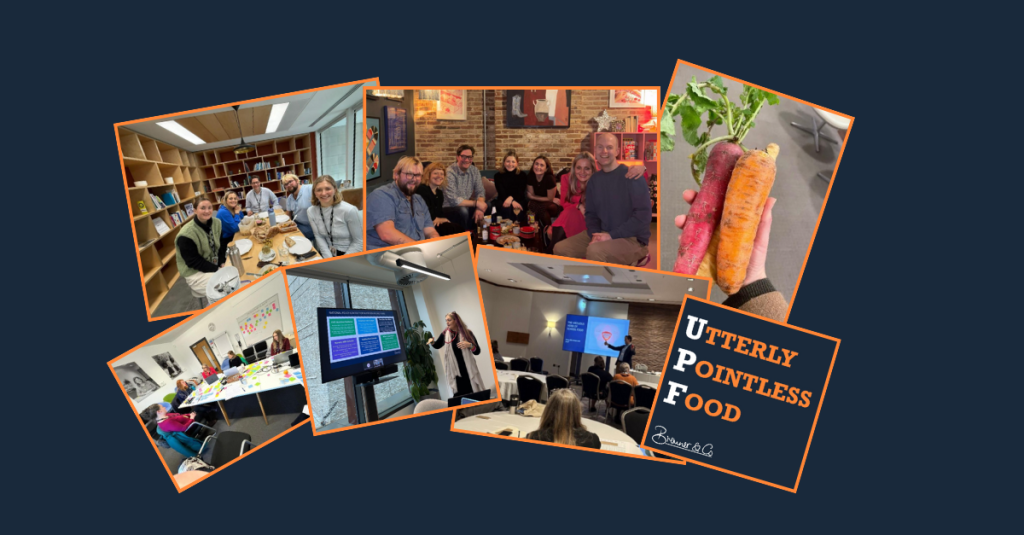
Bring and share lunch
Bremner & Co
4th November
This simple team practice is one of the things that keeps us grounded and connected at Bremner & Co. Every month or so, on the occasions where our schedules align, we each bring in some food and we sit down, share, and eat together. Our lunchtime potlucks give us a brief pause, but a valued one. This month’s spread included a ratatouille, pizza-style pasta salad, Bold Bean Greek salad, fresh fruit for dessert, and, as ever, Dayna’s delicious home-baked sourdough.

Our Bring and Share lunch!
Auto-enrolment webinar for unitary councils
Bremner & Co, Basis, and the Local Government Association
4th November
It was brilliant to see over 160 participants from more than 50 local authorities at the second LGA webinar on free school meal auto enrolment. The turnout showed how much interest there is in getting ready for the October 2026 census. The national picture is clear. Entitlement will widen under Universal Credit, and systems need to ensure that eligible children are actually registered. Torbay’s case study illustrated what is possible. Their team used Local Welfare Provision data and matched it with school census and council datasets. This identified 930 families and led to 223 new pupils being registered for FSM, unlocking around £300,000 of additional Pupil Premium funding for Torbay’s schools. The team shared valuable lessons and the discussion closed on the scale of the opportunity for local areas to show what can be achieved and make this changing policy count for children.

An advert for the LGA webinar
A decade of action: The Healthy Weight Declaration after ten years
Food Active
11th November
Food Active’s annual conference brought together nearly 200 delegates to reflect on ten years of the Healthy Weight Declaration and explore how local and regional action can counter commercial influences on health. Rosie found it great to hear from local leaders around the country on the progress they’ve made in their region, as well as looking ahead to future challenges and opportunities. Rosie was particularly interested to hear about schools’ ‘Pledge for a Healthy and Active Future’ and whole school approaches being taken in Leeds, Cheshire, and Merseyside. A key takeaway for us was to reflect on the role school food can play in supporting these holistic approaches to child health and wellbeing at local and regional levels.
Food for Life’s ‘Supply Chain+’ webinar
Soil Association and AgileChain
13th November
Harry attended this webinar, which presented Food for Life’s new Supply Chain + procurement platform. The platform allows farmers and producers to upload real-time qualitative data about how their food is grown and processed, along with their produce for sale. Buyers can then get a deep understanding of how the food they buy really impacts the land on which it has been produced. It connects directly to an issue we identified in our ‘Follow the Carrot’ report, where hidden data and fragmented procurement information made it difficult for schools and councils to track spend or understand assurance and origin. Ambitions were high, and if Food for Life and AgileChain can make the project self-sustaining, it could prove to be a fantastic tool in improving supply chains.

Dayna presenting at the Good Food Local London Council’s Network
Ofsted’s renewed inspection approach – Ask an Early Years Inspector
Coram Pacey
13th November
Rosie attended Coram Pacey’s webinar with Ofsted’s early years inspection team, where childminders were able to ask how the revised framework will shape day-to-day practice. Ofsted highlighted a stronger focus on support for children facing disadvantage, but many attendees felt expectations were still unclear and that messages about what needs to be demonstrated in a setting remained mixed. We raised questions on food provision and nutrition. The response was that the framework will not set out a checklist and that inspectors will rely on childminders to evidence a healthy diet. While this was presented as flexibility, there was concern that the guidance is too vague and that clearer expectations would support childminders who want to meet the standard with confidence.

A picture from the Lancet Series launch on how UPFs substitute other foods in people’s diets
Launch of the Lancet Series on Ultra-processed Foods and Human Health
Lancet
19th November
The Lancet Series on ultra processed foods launch was striking for its clarity. The science is now hard to dispute and the scale of commercial influence on what people eat was laid out plainly. Speakers described how UPFs have reshaped our food system and why the UK sits near the top of global consumption. One of the most compelling points for Dayna was about infants and toddlers, who are heavily exposed through commercial baby foods and need far stronger protection. Myles reflected on the fact that the debate risks getting tangled in definitions of what is and isn’t processed and that we should not lose sight of something far simpler: children need real food cooked by real people and there is no place for utterly pointless food anywhere the state pays to feed them. The question now is how quickly this evidence pushes policy makers to act.

Myles’ alternative definition of UPFs
Bridging the Gap Westminster launch
Sustain
25th November
Rosie attended the launch of Bridging the Gap’s new report, which brought together voices from across the sector and government to reflect on two years of pilots that helped people on low incomes access climate and nature friendly fruit and veg. The report makes a strong case for government to back this work at scale through real investment in the horticulture sector, stronger supply chains for small and medium producers, and better use of public sector food to create stable routes to market.

The party bags from Bridging the Gap were very exciting!
Nourishing Our Future strategic communications workshop
Essex County Council, Anglia Ruskin University, and Bremner & Co
26th November
Dayna and Rosie joined the Nourishing Our Future team at Essex County Council and Anglia Ruskin University for a strategic communications workshop that took stock of the programme’s core themes. The session focused on audiences, framing, and how to communicate the value of early years work in ways that speak to the people who make decisions. A significant part of the discussion centred on language. Parents tend to say childcare, the media uses the same term, whilst the sector prefers early education and care. Finding wording that feels true to the work but still lands with external audiences is an ongoing challenge. The day worked because public health, education, partnerships, research and programme teams contributed equally, showing how effective collaboration can accelerate local authority innovation. Emily Fallon continues to steer an ambitious and grounded programme that is shaping real progress in Essex.

Dayna and Rosie workshopping communication strategy with the NOF team
Unearthing Empire 2: community projects in practice
Sustain, Roots to Work, Culture Roots Collective, and Eating Better
26th November
Harry attended the second Unearthing Empire webinar, which brought together landworkers, organisers and activists who are reconnecting with ancestral food traditions and rethinking what community nourishment can look like in the UK. The session moved from radical dietetics to seed keeping and local food organising, showing how cultural foodways can be a source of empowerment and restoration rather than something marginal to mainstream food policy. It was a clear reminder that conversations about the food system often miss the histories and lived experiences that shape how communities feed themselves, and that any serious work on access, health and equity needs to start from those perspectives.
Bremner & Co Christmas party
Bremner & Co
26th November
We celebrated our Christmas party with drinks and nibbles with our Associate Consultants Abigail Page and Rob Kidd, before tackling a Wild West themed escape room. We role played sheriffs and outlaws, shot down targets at the gun show, and made it out with a carriage load of gold! Thanks to the wonderful Cressida and Rosie for organising another cracking Christmas party!

A snapshot from our Christmas party
Institute of School Business Leadership annual conference
Institute of School Business Leadership
28th November
Myles spoke at the Institute of School Business Leadership conference on the real costs of a school meal. The session highlighted just how stretched budgets have become and how difficult it is for schools to navigate multiple funding streams to feed children well. His key point was the need for a simpler model. A single school food premium that covers a child’s nutrition across the day, rather than separate pots for breakfast, lunch and individual schemes. There was also support for replacing flat per meal rates with a fixed grant plus funding per pupil, giving schools a more stable base. With expanded eligibility and new standards on the way, the case for a full review of the school food funding system was hard to ignore.

Myles speaking at the ISBL conference
Good Food Local London Council Food Network
Sustain
1st December
Dayna spoke at Sustain’s Good Food Local London Food Network event on why early years must sit at the centre of local food strategies. The discussion underscored three things. Most under-fives spend much of their day in childcare, so settings play a major role in shaping diets. Gaps in early years nutrition remain significant, especially for children in poverty. And as funded childcare expands, more children will be in formal settings where mealtime support can make a real difference. Dayna also highlighted councils that are already moving this agenda forward, from guidance compliant menus to universal early years meals and joined up work across health and early education. The event showed promising practice but also how much further local areas can go to improve food provision for the youngest children.

Dayna with Emily Fallon and Dr. Kay Aaronricks at the Good Food Local event
That wraps up our events coverage for the year. We look forward to sharing more in the new year.

Celebrating the daring escape at the Christmas party!