
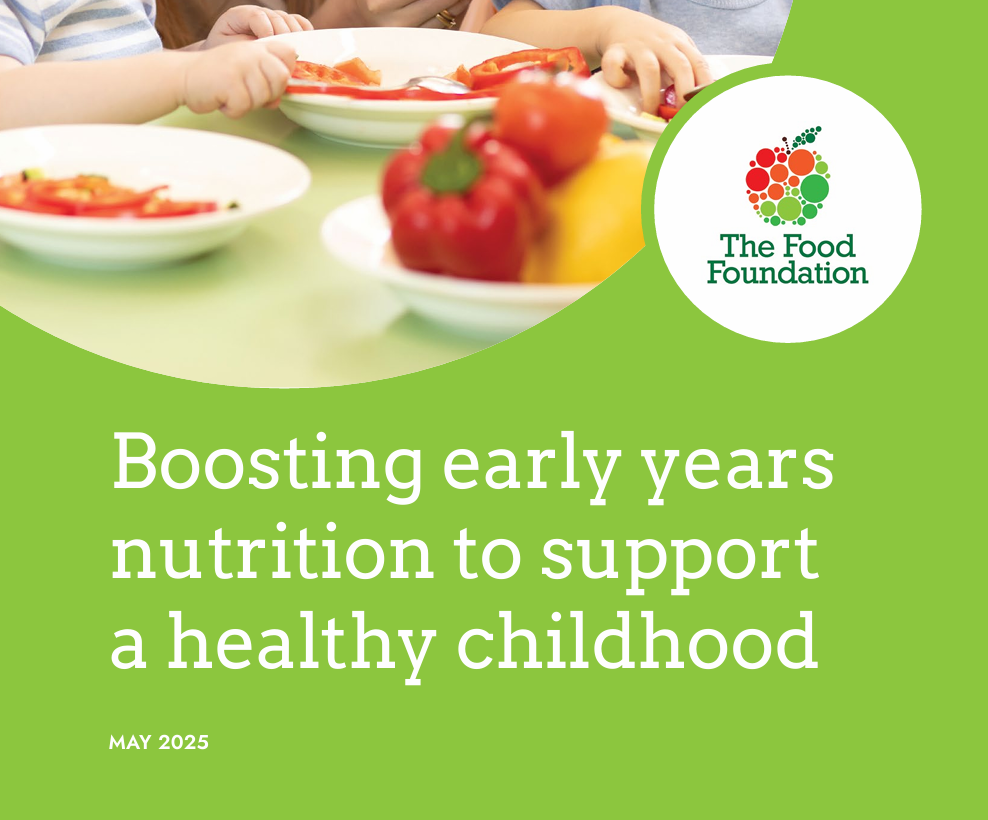
The Food Foundation’s latest report is the final in its three-part series on nutrition during a child’s early years. Boosting Early Years Nutrition to Support a Healthy Childhood focuses on children aged 1 to 5, exploring the food environments they grow up in-from commercial baby snacks and toddler milks, to the meals served in childcare settings, and the nutritional quality of everyday family food.
The report highlights significant gaps in policy and provision, and puts forward practical, evidence-based recommendations to better support families and improve children’s health outcomes.
A complex food landscape for young children
The report explores the wide range of foods children encounter during this critical life stage:
- Commercial baby and toddler foods: Examining the nutritional content and marketing strategies shaping what ends up in children’s lunchboxes and on family shopping lists.
- Childcare settings: Assessing the provision and quality of meals and snacks provided in nurseries, childminders, and early years settings.
- The wider retail market: Recognising that children under five also eat what the rest of the family eats, the report considers broader issues of affordability, price promotions, and product reformulation in the retail sector.
Key findings
Despite widespread recognition of the importance of good nutrition in the early years, this report highlights significant barriers that continue to undermine children’s health, particularly for those in low-income families.
- Persistent health and diet inequalities: Children from the most disadvantaged backgrounds are twice as likely to experience obesity and tooth decay. They also eat significantly less fruit and vegetables – around a third less fruit and a fifth less veg – compared to their more affluent peers. Across all households, diets are too high in fat, sugar and salt, and lacking in vital micronutrients.
- Cost remains a key barrier for families: Over a third (35%) of surveyed parents said cost prevents them from feeding their children the way they would like. The same proportion highlighted that access to more affordable food options would be the most helpful form of support.
- Support schemes are falling short: Schemes such as Healthy Start and Free Early Years Meals are not reaching all eligible families. Tight income thresholds and restrictive eligibility rules mean many children in poverty miss out – including an estimated 200,000 not receiving FEYM despite qualifying for other child poverty support. Additional hurdles include limited availability in non-state settings and issues with sessional care access. The value of Healthy Start vouchers has also failed to keep up with inflation, limiting their impact.
- Widespread marketing of toddler foods: Packaging for baby and toddler snacks frequently features marketing claims – over 2,000 were found across 131 products – yet many of these items are high or medium in sugar. On average, healthier options cost 70% more and often lack key nutrients.
- Challenges in early years provision: Nutrition guidance for early years settings is inconsistent, and many providers are struggling with the cost of providing healthy meals. Greater government support is needed to help settings offer nutritious food to all children.
Policy recommendations
The Food Foundation sets out a powerful case for change, recommending:
- Expanding Free Early Years Meals: Widening eligibility to reach all children in poverty and increasing access across childcare settings.
- Reforming the Healthy Start scheme: Raising the value of vouchers in line with inflation, expanding who is eligible, and moving to an opt-out model to improve uptake.
- Regulating commercial baby foods: Introducing stronger standards on nutrition and tighter rules on how products are marketed to parents.
- Funding healthy food in childcare: Supporting early years providers with resources to serve nutritious food, with a view toward future mandatory food standards.
- Changing food industry incentives: Using taxation, mandatory reporting and reformulation targets to shift the wider food system toward better nutrition.
Our contribution
We were proud to collaborate with the Food Foundation on new analysis for this report, using government datasets to estimate the number of young children missing out on Free Early Years Meals (FEYM) due to current eligibility rules.
Our estimates suggest that over 300,000 children under five, living in poverty and attending formal childcare in England, are not currently accessing FEYM. This includes:
- Around 200,000 children who meet the criteria for other means-tested child poverty interventions; including Early Years Pupil Premium and 2-year-old disadvantage provision, but do not qualify for FEYM
- 84,000 children who are excluded based on the type of childcare setting they attend
- 31,000 children who meet the eligibility criteria but face barriers to registration or sessional care use
This analysis highlights how structural gaps in the current system are preventing low-income families from accessing nutritious meals for their children. Reforming eligibility thresholds and addressing access barriers could significantly increase the number of children receiving regular, healthy food through early years provision.
As the report notes, some local areas, such as Westminster, have already rolled out universal FEYM across settings, achieving high uptake of hot meals and helping to reduce inequalities in nutrition during this vital stage of development.
This work reflects our ongoing commitment to driving policy change grounded in evidence and focused on improving outcomes for children.
Read the full report
Boosting Early Years Nutrition to Support a Healthy Childhood is a vital contribution to the ongoing conversation around food, health and inequality in early childhood. It offers a clear set of next steps for government, local authorities, and providers alike.
To read the full report, click here.